9. Jacob's Ladder (Genesis 28)
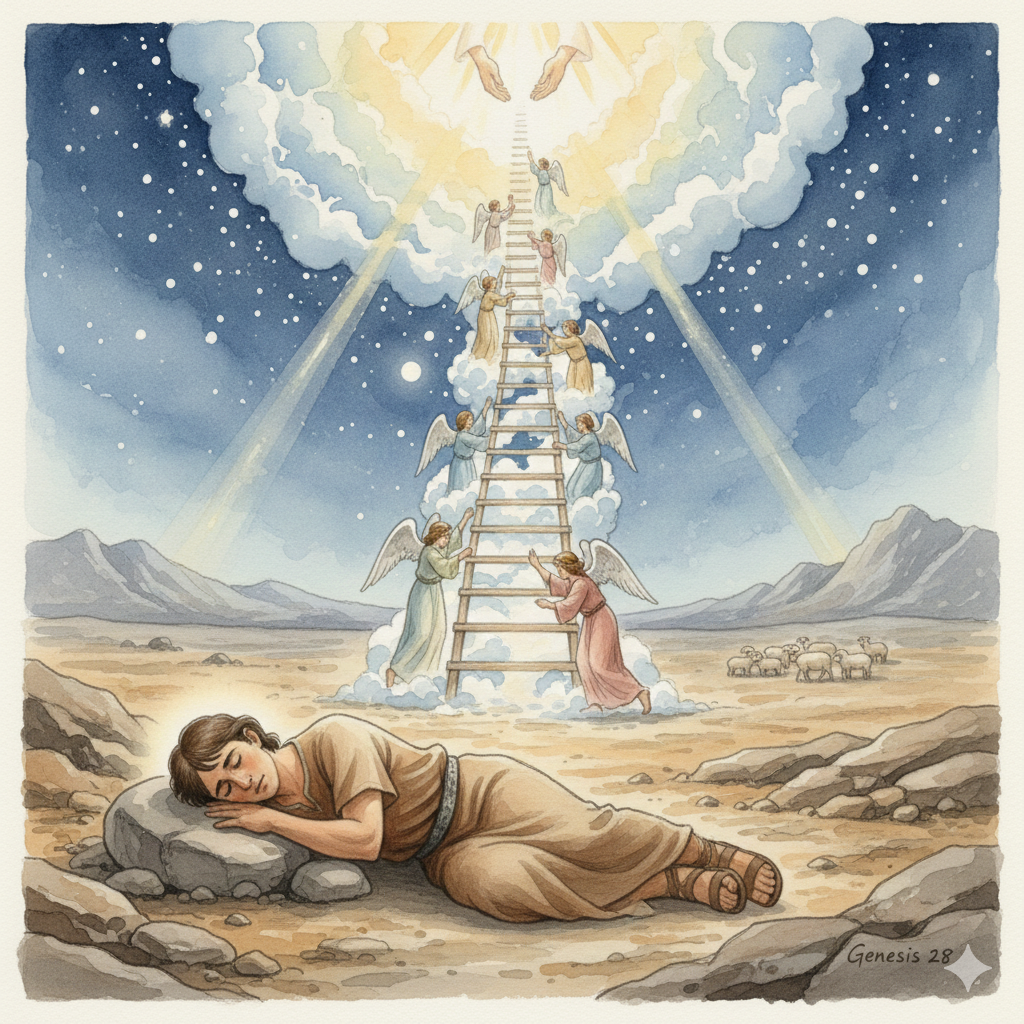
Jacob was in a moment of great loneliness and fear. He was fleeing his home to escape the rage of his brother Esau and was heading toward an unknown land. As night fell in a solitary place, he took a stone for a pillow and fell asleep. In that moment of vulnerability, God granted him an extraordinary vision: a ladder resting on the ground with its top reaching to the heavens, and God’s angels were going up and down on it. At the top of the ladder, the Lord Himself spoke to him.
God's message to Jacob was not one of reproach for his past mistakes, but of comfort and hope. The Lord confirmed the promise made to Abraham and Isaac: "I am with you; I will protect you wherever you go and bring you back to this land." This vision of the ladder is a symbol of communication between God and humanity. It teaches us that God is not far away, but that there is a constant "bridge" between heaven and earth, and that He watches over our paths even when we feel lost or like fugitives.
Upon waking, Jacob was filled with sacred awe and exclaimed: "Truly, the Lord is in this spot, although I did not know it!" He named that place Bethel, which means "House of God," and set up the stone he had used as a pillow as a memorial. Jacob realized he was not alone in his exile. For Christians, this ladder foreshadows Jesus Christ, who is the true way that definitively unites heaven and earth, allowing us access to friendship with God.
Key Points according to the Bible
- God's Presence in Trial: God appears to Jacob when he is most desolate.
- The Ladder as Communication: The angels "ascending and descending" represent providence and prayer.
- Bethel, the House of God: It teaches us to recognize God's presence in our daily lives.
- Jesus, the New Ladder: In the New Testament, Jesus identifies Himself as this living link between heaven and earth.
Biblical Text
Consult the full biblical text of Jacob's dream here: USCCB - Genesis Chapter 28
Reflection Activities: Genesis 28
| 1. Text Comprehension: What did Jacob see in his dream, and what was the main promise God gave him? |
| 2. Doctrinal Content: What does the name "Bethel" mean, and what does it teach us about God's presence in the world? |
| 3. Catechetical Application: How can the promise "I am with you" help us today in our moments of fear or uncertainty? |